Sunday, February 27, 2011

Imitating our Master

The Imitation of Christ by Thomas a Kempis is one of those bona fide classics that every Christian can profit from, even if you don't agree with everything in it. There are things here that should be daily reminders for pilgrims on the way. I've been dipping into it again. Here are some snippets. . .

Those who fully understand Christ's words must labor to make their lives conform to His.

Knowledge is a natural desire in all people. But knowledge for its own sake is useless unless you fear God. An unlearned peasant, whose contentment is the service of God, is far better than the learned and the clever, whose pride in their knowledge leads them to neglect their souls while fixing their attention on the stars.

Nothing is so beneficial as a true knowledge of ourselves, which produces a wholesome self-contempt.

Always keep in mind that all are frail, but none so frail as yourself.

It is good that everything is not always to our liking; for adversity makes people look into their hearts in order to realize that they are exiles and must not put their hopes in any worldly thing.

The Imitation of Christ is clearly a book by a man who was saturated in scripture and who had a keen sense of the effects of sin. If you've never read it I hope you'll pick it up.


Quotes from pgs. 15, 16, 17, 18 & 30 of this edition

Thursday, February 24, 2011

The end of baptism

Here's another quote from Children of Promise (Geoffrey W. Bromiley) pp. 89-90

Whether we be baptized in infancy or on profession of faith, there is in fact no time when we can say that baptism refers simply to some past or present experience in our own life and that it has meaning and value solely or primarily as a witness to that experience. As a sign of the regenerating, renewing, and resurrecting work of the Holy Spirit it always has a wider as well as a narrower time reference. It begins with Christ's first coming before our present life and it ends with his coming again after our present life. Thus we begin with Christ's death and resurrection for us and we end with our own death and resurrection with him at the last day. Our attainment of this end is the creative work of the Holy Spirit which is declared to us in baptism and which has its initial outworking in conversion and the ongoing movement of renewal. Only when the end has been attained can we say that by the work of the Spirit we have fully entered into the baptism of Christ. But then the thing signified will be present in its totality and the sign and its testimony will no longer be needed.

Bromiley bases the above on passages taken from (among others) Romans 8, 1 Corinthians 15 and 1 Peter 4. This eschatalogical dimension to baptism is not something we're used to considering (or at least I'm not). Typically we think of baptism as something that witnesses merely to an event in the present or past, but the New Testament writers (Paul especially) see baptism as having a future dimension as well. That's one reason why we can say that the efficacy of baptism isn't tied to the moment in time that it happens. There's nothing magical in the water or in the pastor/priest that administers it. The validity of our baptism is demonstrated in a lifetime of being conformed to the image of Christ, and consummated in the final resurrection described in 1 Cor. 15 and elsewhere. How this past/present/future scope of baptism might inform the question of infant baptism I'll leave for you to ponder.

Wednesday, February 23, 2011

If the Bible is God's authoritative word. . .

- That means it speaks to us words that are not always what we would say to ourselves.

- That means it speaks to us words that are not always what we want to hear.

- That means it speaks to us words that are not always what the culture speaks.

via Rev. Henry Greene

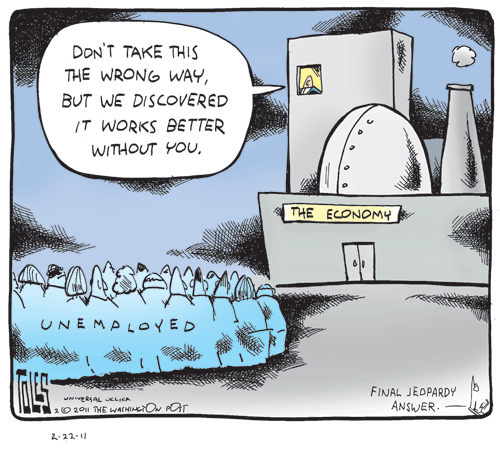
Lock-out


by Tom Toles

Monday, February 21, 2011

He was born in Kentucky, raised in Indiana, and lived in Illinois

Some classic American cinema for your Presidents' Day. Henry Fonda as Abe Lincoln. . .


Young Mr. Lincoln (dir. John Ford, 1939)

Friday, February 18, 2011

Machen on the radio

In 1935 J. Gresham Machen gave a series of talks on Philadelphia radio station WIP. They were published under the title The Christian Faith in the Modern World. Best I can tell it's out of print, but I scored a copy at a used book sale at our church. This is vintage Machen -- clear, concise and unflinching in defense of truth.

The world was a scary place in 1935. Machen remarks in the first talk called "The Present Emergency" that humanity is standing over an abyss. The "war to end all wars" was still fresh in the public mind, America was in the grip of the Great Depression, and another world war loomed on the horizon. Yet with all that Machen had the audacity to go on the radio and affirm that the most pressing emergency facing mankind had to do with God and the unseen world. More specifically, the most urgent question facing humanity is how can one be right with God. The world is still a scary place, and that question still presses in on sinners who wake up to their perilous position under the wrath of a holy and just God.

Machen began by sketching a rudimentary doctrine of the knowability of God and then proceeded to explain and defend basic Christian doctrines in confessional Protestant terms. As a leading New Testament scholar it's not surprising that Machen spent a good chunk of these talks on the doctrine of Scripture. How can we say that the Bible is God's word? How can we believe every word in the Bible is inspired? What does that mean exactly?

After answering those questions and explaining what it means to say we believe in the full "plenary" verbal inspiration of the Bible -- and just as importantly what it doesn't mean (e.g. the human authors weren't mere stenographers for the Holy Spirit, nor were their natural abilities and literary styles obliterated by the receipt of divine revelation) -- Machen ends by affirming that for the Bible to be good news it must be more than a record of inspiring religion. It must be more than a manual for living. For the Bible to be good news for sinful men and women it must be a record of facts.

The Bible does tell me the facts. It tells me Jesus died on the cross to save me; it tells me He rose from the dead to complete His saving work and be my living Lord. What do I say when it tells me that? Do I say: "That is history and not religion: I am not interested in it; it may be true or it may not be true for all I care; the Bible is a book of religion and not a book of science or a book of history"? No, my friends, I do not say that. I say rather: "Praise be to God for that blessed story of the resurrection and the cross; upon the truth of it all my hope depends for time and for eternity; how I rejoice that God Himself has told me in His holy Book that it is true!"

Here is a rule for you, my friends: no facts, no good news; no good news, no hope. The Bible is quite useless unless it is a record of facts.


Quote from "Do We Believe in Verbal Inspiration?"

Wednesday, February 16, 2011

America's favorite temperance drink

I've been listening to the latest episode of This American Life, in which Ira Glass & Co. claim to have found the secret recipe for Coca-Cola.

I don't drink the stuff, but I'm fascinated by the history and iconography of this enduring cultural artifact. Much of the mythology of Coke revolves around Coca-Cola's inventor, druggist John Pemberton. Like many Confederate veterans Pemberton became addicted to morphine -- the drug of choice for treating wounded soldiers. After the war he began experimenting with a concoction that contained extract from coca leaves, as in cocaine. The hope was that it would help wean addicts off of their dependence on morphine. His first product was a wine containing caffeine, and yes, cocaine. Must have been quite the energy drink! When temperance mania hit Atlanta; Pemberton realized he needed to adapt to the changing social mores. He removed the alcohol from his beverage, tinkered some more and -- voila! -- the primitive version of Coca-Cola was born. It's his recipe that Ira Glass attempts to reproduce on this week's show.

Interestingly enough; coca leaves are still used in the official formula, but not before they're de-cocainized at a plant in New Jersey. That makes the Coca-Cola Company one of the biggest importers of a Schedule II controlled substance in the country!

Monday, February 14, 2011

"It's always been you."


Four Weddings and a Funeral (dir. Mike Newell, 1994)

God is love, but love isn't God (C.S. Lewis)

From the introduction to this edition of The Four Loves.

St. John's saying that God is love has long been balanced in my mind against the remark of a modern author (M. Denis de Rougemont) that "love ceases to be a demon only when he ceases to be a god"; which of course can be re-stated in the form "begins to be a demon the moment he begins to be a god." This balance seems to me an indispensable safeguard. If we ignore it the truth that God is love may slyly come to mean for us the converse, that love is God. (pp. 6-7)

We may give our human loves the unconditional allegiance which we owe only to God. Then they become gods: then they become demons. Then they will destroy us, and also destroy themselves. For natural loves that are allowed to become gods do not remain loves. They are still called so, but can become in fact complicated forms of hatred. (p. 8)

Good words on this day devoted to love from the wisest book I've ever read on the subject. It's worth noting that Lewis isn't denigrating human loves. Romantic love, love of family, friendship, and love of country are all examples of love to be celebrated. They all reflect aspects of the divine love. It's when these loves become the ultimate thing, the highest good, that they carry within themselves seeds of poison.